The Parliamentary Ad-hoc Committee invest igating the June 10 2024 military plane crash has queried conflicting accounts of when the wreckage was discovered.
Yesterday, the committee heard from Major General Richard Tobias Chagonapanja, former Commander of 101 Brigade and current Chief of Staff of the Malawi Defence Force (MDF), who said the wreckage was discovered at 10.58am on June 11 2024.
His account prompted committee chairperson Walter Nyamilandu to highlight the contradiction with the Malawi Police Service version that the discovery was at 9.30am.
“It is baffling and, as a committee, we need to figure out the timeline. So, we will continue with our investigations to corroborate
information from Malawi Police and MDF, to determine the exact time because that has major implications,” said Nyamilandu.
He said the conflicting accounts also pointed to coordination problems during the initial search.
Chaonapanja was summoned to account for the search-and-rescue operation he coordinated after the aircraft went missing on June 10 2024 until the wreckage was found the following day.
He told the committee he was not informed about the Vice-President’s trip to the Northern Region on June 10 to attend the burial of former Cabinet minister Ralph Kasambara.
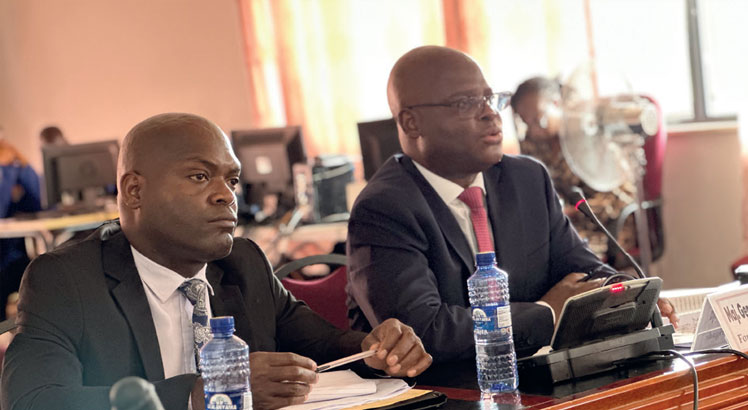
his colleague listens. | Jacob Nankhonya
Chagonapanja said he only learnt at 12.15pm that the aircraft had lost communication with both Mzuzu and Lilongwe air traffic control and had failed to land as expected.
He said he made several phone calls before being instructed to begin search-and-rescue operations. He said his first report was given to then MDF Commander General Paul Velentino Phiri (retired) at around 5pm.
Chagonapanja said an inter-stakeholder meeting at 8.35pm proposed suspending the search because of bad weather and coordination challenges, but MDF continued searching that night.
He said the tactical physical pause was necessitated by poor preparedness for night operations and difficult weather conditions, including thick fog.
Chagonapanja said that by 10pm, most teams had left the area, leaving MDF personnel and Raiply patrols to continue the search.
He said 180 soldiers were deployed between June 10 and 11, adding that the number was sufficient for a successful search-and-rescue operation if adequate resources had been available.
But he faulted what he described as an uncoordinated operation, saying police had pointers to the possible location of the aircraft but did not share the same with the MDF, leaving MDF to rely on witnesses whose accounts were conflicting.
On Monday this week, Inspector General of Police Richard Luhanga, who was Northern Region Police Commisssioner at the time of the accident, also described the search-and-rescue as disjointed and archaic.
Chagonapanja said search operations were re-coordinated from 4am the following day, with other stakeholders, including police joining the search.
His testimony also revealed that Chilima had three phones, two of which were in usable condition while the third had cracks.
Zomba City South legislator James Mpunga (Democratic Progressive Party) questioned instructions allegedly given to Chagonapanja not to take photographs when the wreckage was discovered.
In response, he said the instruction was given to preserve order at the scene.
Nyamilandu said the committee will engage other stakeholders to establish the exact timeline of the wreckage discovery.
Today, the committee will move to the Northern Region, where members will engage witnesses and other officials.